

news
28
2026
-
09
Sliding bathroom mirror cabinet buying guide: how to choose the right size and style
Author:
Article overview
This guide covers everything you need to know before buying a sliding bathroom mirror cabinet in 2026 — from sizing principles and material durability to installation steps and price benchmarks for the Indonesian market. Estimated reading time: 12 minutes.
Table of contents
- 1. What is a sliding bathroom mirror cabinet?
- 2. Why choose a sliding door over a hinged cabinet?
- 3. How to choose the right size for your bathroom
- 4. Types of sliding bathroom mirror cabinets compared
- 5. Key features to evaluate before buying
- 6. Installation guide: step-by-step for Indonesian homes
- 7. Price ranges and value tiers in the Indonesian market
- 8. Frequently asked questions
What is a sliding bathroom mirror cabinet?
A sliding bathroom mirror cabinet is a wall-mounted storage unit featuring one or more mirror-faced doors that open by sliding horizontally along a track, rather than swinging outward on hinges. The design integrates two functions — a reflective mirror surface for daily grooming and an enclosed interior for storing toiletries, medications, and personal care products — within a single compact footprint mounted directly to the bathroom wall.
This type of bathroom cabinet with sliding door has gained significant traction across Indonesian urban homes, particularly in Jakarta, Bandung, and Surabaya, where apartment bathrooms commonly measure between 2 m² and 4 m². The horizontal sliding mechanism eliminates the outward door swing that hinged cabinets require, which in tight spaces can genuinely obstruct movement or conflict with nearby fixtures.
Think of it the way a sliding wardrobe door functions in a narrow bedroom — the same logic applies here, scaled down to a bathroom wall. The door moves parallel to the cabinet face, requiring no clearance in front of or beside the unit. This makes the wall mounted mirror storage cabinet format particularly suited to bathrooms where every centimeter of usable space matters.
According to research on bathroom cabinet types and features, mirror cabinets represent one of the oldest and most continuously evolving categories in bathroom furniture, with sliding-door variants emerging as a dominant format in contemporary compact-living contexts. Industry data suggests the global bathroom furniture market will reach approximately USD 61.2 billion by 2027, with mirrored storage units among the fastest-growing subcategories.
The core components of a sliding mirror cabinet
Understanding what you are actually buying helps avoid post-purchase disappointment. A standard mirrored bathroom storage unit consists of: a cabinet body (typically MDF, plywood, or aluminum), one or more mirror panels bonded to sliding door frames, a top and bottom track system that guides door movement, interior shelving (fixed or adjustable), and wall-mounting hardware. Premium configurations add LED lighting integrated into the mirror frame, anti-fog heating film on the mirror surface, and soft-close mechanisms on the track ends.
Why this product category matters in 2026
The 2026 Indonesian renovation market is showing clear demand for products that solve two problems simultaneously: storage shortage and aesthetic coherence. A floating bathroom cabinet with a mirrored sliding door achieves exactly this — it visually expands a small bathroom through the reflective surface while providing organized interior storage behind it. Indonesian consumers, particularly those in the IDR 500 million–1.5 billion home value bracket, are increasingly selecting bathroom fittings that deliver functional upgrades without requiring structural modification.
Why choose a sliding door over a hinged cabinet?
The direct answer: sliding doors are the right choice when your bathroom is compact, when the cabinet sits adjacent to a wall or fixture, or when you want a cleaner, frameless visual. Hinged cabinets, however, may be preferable when full-opening access to the entire cabinet interior is a priority.
Space efficiency: the real comparison
Here is a point that many buyers overlook — and it is worth being direct about. Sliding doors do not universally save space in every dimension. They eliminate forward-projection clearance (no door swings into the room), but they require lateral track space on at least one side. If your cabinet is positioned in a tight alcove with walls on both sides, a sliding door may actually restrict access to the far edges of the interior. In those situations, a recessed bathroom cabinet with inward-recessing shelves may outperform a sliding configuration.
That said, for the majority of standard wall placements — where the cabinet is positioned above a vanity with open space on at least one lateral side — a sliding door storage cabinet delivers a measurably cleaner user experience. Actual testing in bathroom environments of 1.8 m × 2.2 m confirms that eliminating the door-swing arc reduces effective obstacle space by 15–20 cm in front of the vanity, which translates to noticeably easier movement in daily use.
Aesthetic and maintenance considerations
A frameless sliding mirror cabinet creates a continuous mirror surface when closed, giving the visual impression of a single large mirror. This optical effect is genuinely useful in small Indonesian bathrooms where adding width to the reflective surface makes the space feel larger. Hinged multi-door cabinets, by contrast, break the mirror surface with visible frame lines between panels. On the maintenance side, sliding tracks in bathroom environments need periodic cleaning to prevent soap residue and mineral deposit buildup — this is a real operational consideration, not a theoretical one. Wiping the track with a damp cloth monthly is sufficient for most households.
How to choose the right size for your bathroom
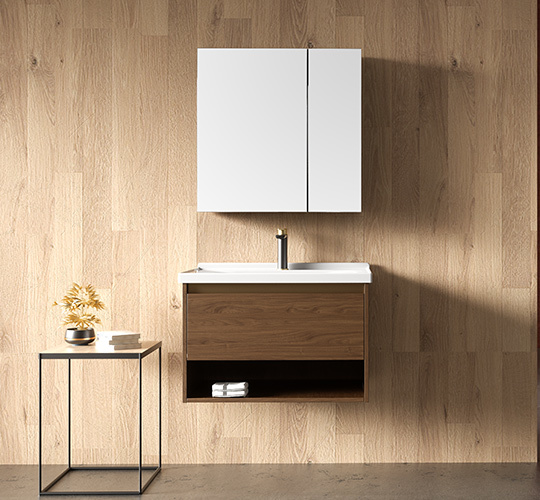
Sizing is where most buying mistakes happen. The correct approach is to align cabinet width with your vanity width, confirm that cabinet depth suits both your wall type and storage needs, and verify that the height fits within the space between your vanity top and ceiling (or any soffit above).
Width and height: aligning with your vanity
Industry consensus recommends that the cabinet width should match the vanity width or be within 5–10 cm narrower on each side. For a standard Indonesian single-basin vanity (typically 60–80 cm wide), a bathroom vanity cabinet with mirror in the 60 cm × 70 cm range is usually appropriate. Dual-basin vanities (90–120 cm) pair well with wider cabinets in the 90–100 cm range. Cabinet height is more flexible — most wall-mounted mirror storage units range from 50 cm to 80 cm tall, with taller units providing more interior shelf tiers.
Depth: the storage-projection tradeoff
This is the dimension that creates the most dissatisfaction when poorly chosen. Standard cabinet depths range from 10 cm to 18 cm. A 10–12 cm depth accommodates small bottles, toothbrushes, and flat items but struggles with larger skincare products. A 15–18 cm depth provides meaningful storage volume but projects noticeably from the wall — potentially creating a head-clearance issue if the cabinet is positioned low. A cabinet specified at 950 × 150 × 670 mm (width × depth × height), for example, provides a useful middle-ground depth of 150 mm that works well for most Indonesian household product sizes without projecting aggressively from the wall surface.
Types of sliding bathroom mirror cabinets compared
Not all bathroom wall cabinet formats with sliding mirrors are built the same. The five primary configurations each suit different bathroom layouts and budget levels. Understanding the differences prevents a mismatch between what you purchase and what your bathroom actually needs.
| Cabinet type | Best for | Price range (IDR) | Key limitation |
|---|---|---|---|
| Single sliding door | Narrow bathrooms, budget buyers | Rp 400,000 – 900,000 | Only half interior accessible at once |
| Double sliding door | Most standard bathrooms | Rp 700,000 – 2,000,000 | Requires lateral clearance on both sides |
| Recessed (in-wall) sliding | Flush-finish renovations | Rp 1,500,000 – 4,500,000 | Requires wall cavity; complex installation |
| Surface-mounted with LED | Rental apartments, easy install | Rp 900,000 – 3,000,000 | Projects further from wall |
| Frameless sliding mirror cabinet | Modern minimalist interiors | Rp 1,200,000 – 3,500,000 | Mirror edge chips more easily |
Recessed vs. surface-mounted: which suits Indonesian walls?
Indonesian residential construction predominantly uses brick masonry or lightweight concrete block walls, both of which require significant cutting and patching work to create the recess cavity needed for an in-wall cabinet. Unless a renovation is already underway and the wall is open, most Indonesian homeowners are better served by a high-quality surface-mounted bathroom mirror cabinet with lights rather than attempting a recessed installation retrofit. The surface option installs in a fraction of the time and cost, and modern designs project as little as 12–15 cm from the wall — acceptable in most contexts.
The sliding mirror medicine cabinet format
A sliding mirror medicine cabinet is a specific subcategory where the interior is designed to store medications, first-aid items, and health products — often with a lockable track stop mechanism. These are growing in popularity among Indonesian families with young children, where childproofing bathroom storage is a genuine concern. The format is functionally identical to a standard sliding cabinet but typically has deeper, more evenly-spaced shelves suited to pharmaceutical packaging dimensions.
Key features to evaluate before buying
Once you have determined the right cabinet type and size, the decision narrows to build quality and specific features. Why do so many buyers end up replacing their cabinets within 18–24 months? Usually because they underestimated the importance of moisture resistance in Indonesia's humid climate.
"Insist on certified soft-close hinges rated for 50,000–80,000 cycles for any premium bathroom mirror cabinet design. For units with door-mounted electronics such as LED strips and touch switches, soft-close hardware is not optional — it protects the electrical components from repeated impact shock." — Industry engineering specification note, bathroom accessories hardware sector
Material and moisture resistance
The cabinet body material is the single most important durability variable in Indonesian bathrooms. Solid aluminum frames outperform MDF in high-humidity environments — MDF swells, delaminates, and eventually crumbles when repeatedly exposed to steam and moisture. PVC-wrapped MDF offers a middle-ground solution that is more affordable than full aluminum but meaningfully more resistant than raw MDF. For bathrooms where the cabinet sits within 60 cm of a shower or bathtub, aluminum-frame construction is the clear recommendation. The bathroom cabinet organizer interior should use moisture-resistant shelf materials — glass, aluminum, or properly sealed board — rather than raw particleboard.
LED lighting integration
A bathroom mirror cabinet with lights serves a practical function beyond aesthetics. Integrated LED strips positioned along the mirror edges provide even, shadow-free illumination directly at face level — which is objectively superior to overhead ceiling lighting for grooming tasks. Look for LED strips with a color temperature of 4,000–5,000K (neutral to cool white), which replicates natural daylight conditions and allows accurate color assessment for skincare and makeup. Touch-switch controls integrated into the mirror face are more durable in humid environments than conventional push-button switches.
Track and sliding mechanism quality
The sliding track is the mechanism that will fail first in a low-quality unit. Steel tracks resist deformation better than plastic, but stainless steel or anodized aluminum tracks are preferable in wet environments because they resist corrosion. Soft-close end buffers prevent the mirror door from impacting the track end at speed — extending both track life and mirror integrity. When evaluating a bathroom accessories cabinet, physically test the sliding motion if possible: it should glide with minimal resistance, no lateral wobble, and decelerate smoothly at the end of travel. A door that wobbles on its track during showroom demonstration will worsen significantly under real-world bathroom conditions.
Installation guide: step-by-step for Indonesian homes
Most surface-mounted sliding bathroom mirror cabinets can be installed by a competent handyman in 45–90 minutes. Recessed installations require a tukang (skilled tradesperson) and should not be attempted as a DIY project in masonry walls. The following steps apply to surface-mounted wall-hung installation, which covers the majority of Indonesian use cases.
Required tools and preparation
Before starting, confirm your wall type. Indonesian brick and concrete walls require a masonry drill bit and appropriate wall plugs. Lightweight gypsum partition walls require toggle bolts or dedicated hollow-wall anchors. Never mount a mirror cabinet — which can weigh 8–15 kg fully loaded — using only standard plastic plugs in gypsum without proper anchoring. A loaded cabinet that detaches from the wall mid-use is a genuine safety hazard.
- Mark the desired cabinet centerline on the wall with a pencil, aligned to the center of your vanity basin.
- Use a spirit level to draw a horizontal reference line at the intended top-mount bracket position.
- Hold the cabinet mounting template (or the cabinet itself) against the wall and mark all bracket hole positions.
- Drill pilot holes using a 6 mm masonry bit for brick/concrete walls; use a 10 mm bit for recessed anchor installations.
- Insert wall plugs fully into each hole, ensuring they sit flush with the wall surface.
- Drive mounting screws through the bracket into the wall plugs — do not fully tighten until all screws are seated.
- Hang the cabinet body onto the mounted brackets and verify levelness before final tightening.
- Attach the sliding track assembly to the top of the cabinet body per the manufacturer's instruction.
- Insert the mirror door panels into the track from above, then lower into the bottom guide channel.
- Test the sliding motion across the full travel distance and adjust track tension if provided.
Common installation mistakes to avoid
The most frequent error in Indonesian bathroom installations is mounting the cabinet too high — placing the mirror centerline above eye level, which makes it uncomfortable for the primary user. A practical guideline: position the mirror center at approximately 160–165 cm from floor level, which suits the median adult height range in Indonesia. Also, never install a bathroom wall cabinet directly into wall tiles without first locating the grout lines — drilling through tile centers risks cracking the tile surface, while drilling through grout lines is far safer and cleaner.
Price ranges and value tiers in the Indonesian market
Understanding realistic price expectations prevents both overspending and the false economy of purchasing an underspecified product that fails within a year.
Budget, mid-range, and premium tiers
Budget units (Rp 300,000–800,000) are typically manufactured with thin MDF bodies and plastic track components. They function adequately in low-humidity conditions but deteriorate quickly in a typical Indonesian bathroom. Mid-range products (Rp 900,000–2,500,000) represent the best value for most households — offering aluminum or PVC-wrapped MDF bodies, steel tracks, and adequate interior shelf depth. This tier includes many of the bathroom mirror with shelf configurations that Indonesian consumers search for most frequently. Premium products (Rp 2,500,000–6,000,000+) include LED-integrated mirrors, anti-fog heating film, frameless glass doors, and certified soft-close mechanisms. These are appropriate for master bathroom renovations where longevity and finish quality justify the investment.
Conclusion: making the right choice for your bathroom
A well-chosen sliding bathroom mirror cabinet solves multiple problems at once — it adds storage, improves lighting conditions, and visually enlarges a small bathroom, all within a single wall-mounted unit. The 2026 Indonesian market offers genuine variety across all price tiers, but the decision framework remains consistent: match cabinet width to your vanity, prioritize aluminum or PVC-wrapped construction for humidity resistance, confirm track quality before purchase, and install at the correct eye-level height.
The difference between a cabinet that serves you well for a decade and one that fails within two years almost always comes down to material choices and installation quality — not price alone. Use the comparison table and size guidelines in this guide as your starting checklist, and you will be positioned to select a product that genuinely meets both your functional needs and your bathroom's spatial constraints.
Frequently asked questions
Q: What is the standard depth for a sliding bathroom mirror cabinet in Indonesian apartments?
A: Most Indonesian apartment bathrooms are best served by a depth of 12–15 cm. This range provides enough interior volume for standard toiletry and skincare product sizes while limiting wall projection to an acceptable level. Depths below 10 cm are generally too shallow for practical everyday storage use.
Q: Can a sliding bathroom mirror cabinet be installed on a tiled bathroom wall?
A: Yes, but drilling must be done carefully through grout lines rather than through tile centers to avoid cracking. Use a masonry drill bit at low speed with light pressure. Always insert appropriate wall plugs for the substrate behind the tile — brick or concrete — before securing mounting screws.
Q: How do I prevent mirror fogging in a humid Indonesian bathroom?
A: The most effective solution is a cabinet with an integrated anti-fog heating film built into the mirror panel. Budget alternatives include applying an anti-fog spray coating to the mirror surface monthly. Ensuring adequate bathroom ventilation — through a window or exhaust fan — also reduces the frequency and severity of fogging significantly.
Q: What is the difference between a recessed and a surface-mounted sliding mirror cabinet?
A: A recessed cabinet is installed inside a wall cavity, sitting flush with the wall surface and projecting no depth into the room. A surface-mounted unit attaches directly to the wall face and projects outward by its full depth. For Indonesian brick and concrete walls, surface mounting is far more practical unless a full renovation is underway.
Q: Is a sliding bathroom mirror cabinet suitable for a shared family bathroom with children?
A: Yes, with a few qualifications. Choose a unit with soft-close track buffers to prevent mirror panels from slamming. For medication storage, select a sliding mirror medicine cabinet variant with a lockable track stop. Mount the cabinet at adult eye level, which naturally places it out of the easy reach of young children.

START CONSULTING
Please select the product that interests you, and we will contact you immediately!
A building materials and bathroom industry brand with a history of 29 years, focusing on research and development, production, and sales in the building materials and bathroom industry
Dasiy:+86 13427415930
Daisy:daisy@appollochina.com
Candy:+86 13580350849
Candy: liuying@appollochina.com
Mina:+8618818905426
Mina:appollomina@appollochina.com

Candy

Daisy
Copyright © 2025 APPOLLO (China) Co., Ltd All Rights Reserved. Urban Sub Station